Created by Ignacio Chavez Morales
Turbines
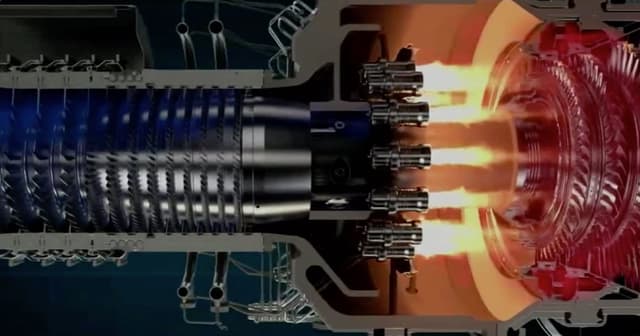
Turbines are machines that develop torque and shaft power as a result of varying the amount of motion of the fluid passing through them.
That fluid can be a gas, vapor or liquid, although the notes given below apply to turbines operating on gas or vapor.
For the fluid to reach the high velocity required for useful momentum variations to occur, there must be a significant difference between the turbine inlet pressure and the exhaust pressure.
![▷ Tipos de turbinas [ 2021 ]](https://www.tiposde.com/wp-content/uploads/tipo-de-turbina.jpg)
Steam turbines are present in various power cycles that use a fluid that can change phase, the most important of which is the Rankine Cycle, which generates steam in a boiler, from which it exits under conditions of high temperature and pressure. In the turbine, the internal energy of the steam is transformed into mechanical energy, which is typically used by a generator to produce electricity. In a turbine, two parts can be distinguished, the rotor and the stator. The rotor is made up of blade wheels attached to the shaft and constitutes the moving part of the turbine. The stator is also formed by blades, not attached to the shaft but to the turbine casing.
To learn more about the turbines you can see it in the following link by clicking on the following image, for further learning and knowledge acquisition: